
The train driver and the bullet train
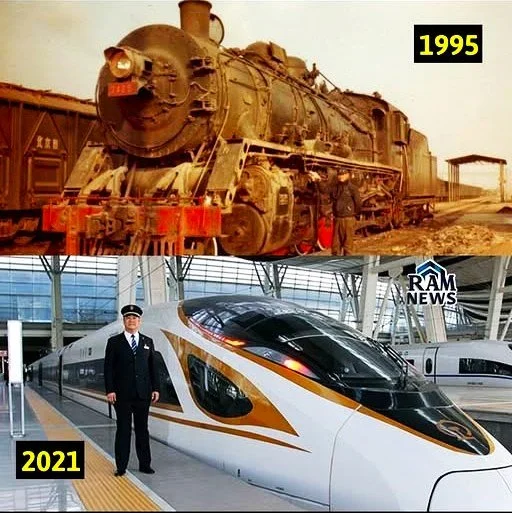
Technology doesn’t wait for people. That’s the problem.
China built one of the most extraordinary rail networks in human history in roughly three decades. The engineering is breathtaking. But engineering itself doesn’t experience uncertainty. It doesn’t grieve old identities. It doesn’t lie awake wondering whether the skills it spent a decade mastering are about to become irrelevant.
Han Junjia (see right) did all of those things. He had to learn eight different operating licences across his career. Eight times, he had to let go of mastery and become a beginner again. Eight times, he had to trust that the discomfort was worth it.
What the headlines don’t tell you is how lumpy that journey must have been. The diesel transition. The move to electric. The leap to high-speed. Each one a different kind of loss before it became a gain.
This is the leader’s actual job.
Not to manage the technology. Not even to manage the change. But to hold the space between where people are and where the organisation needs to go and to do this knowing the gap will never close cleanly. Indeed, it may never close entirely.
I’ve worked with leaders navigating exactly this tension. The ones who struggle are usually trying to resolve the ambiguity; to make it neat, to get everyone on board and ensure that the path is clear before moving. The leaders I know who do this well embrace that ambiguity, carry some of it themselves, while remaining deeply attuned to how it affects others.
It’s an important distinction. You’re not hiding the difficulty. You’re not pretending the transition is smooth. You’re saying, “I know this is hard, I’m not going to pretend otherwise. But, between us, we’ll get there!”
The cost of getting the pacing wrong cuts both ways.
Move too fast and you lose people, not to resistance, but to disorientation. They stop trusting their own judgement. They become dependent or disengaged. The technology arrives, but the human capability to use it well doesn’t.
Move too slow and you create a different problem. You protect people from discomfort in the short term and rob them of growth in the medium to long term. You also, eventually, make the gap so wide that no amount of good leadership can bridge it gracefully.
Han’s organisation (probably through a combination of good design and good luck) paced him well enough that he arrived at the Fuxing with pride, not resentment. “Whenever I drove a new train, I felt the progress of the country’s rail technology,” he said. That’s not a man who was dragged into the future. That’s a man who was led into it, connected to a sense of purpose and progress.
What I keep coming back to
The organisations (or, more usually, the bits of them) I find most interesting right now aren’t the ones with the most advanced technology. They’re the ones where the human capability and the technological capability are broadly in step. They are places where people feel extended by the tools around them, not replaced by them.
That alignment doesn’t happen by accident. It happens because someone (often a leader in the middle of an organisation, closer to the immediate needs and impacts) decided to stay in the uncomfortable space between progress and people. And refused to abandon either.
It’s a competency built from skills and capabilities that can be developed. It’s also a disposition: an inclination, a perspective, a mindset. And while that can be cultivated, of course, it is rarer than you might think.
For Han, when the technology changed, he changed with it. Let’s give him full credit for that. But someone, somewhere along the way, helped make that possible.
That’s the job.